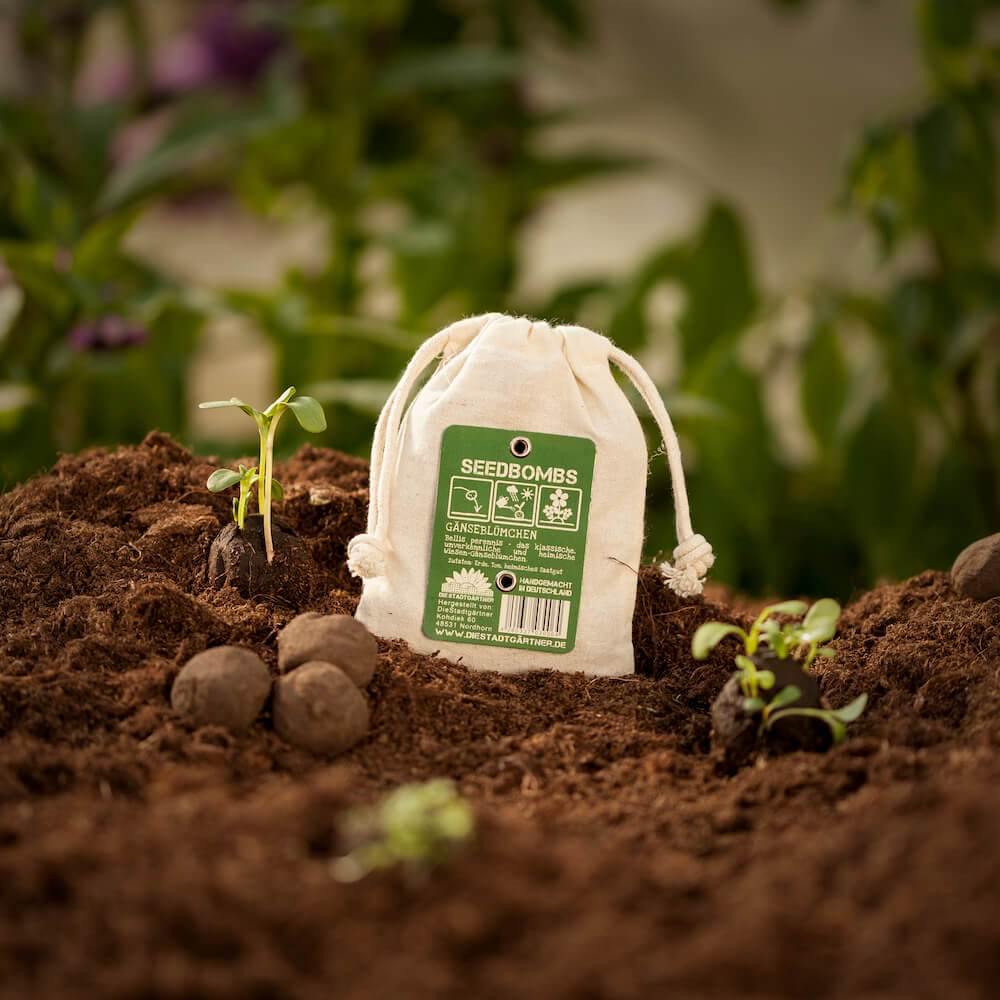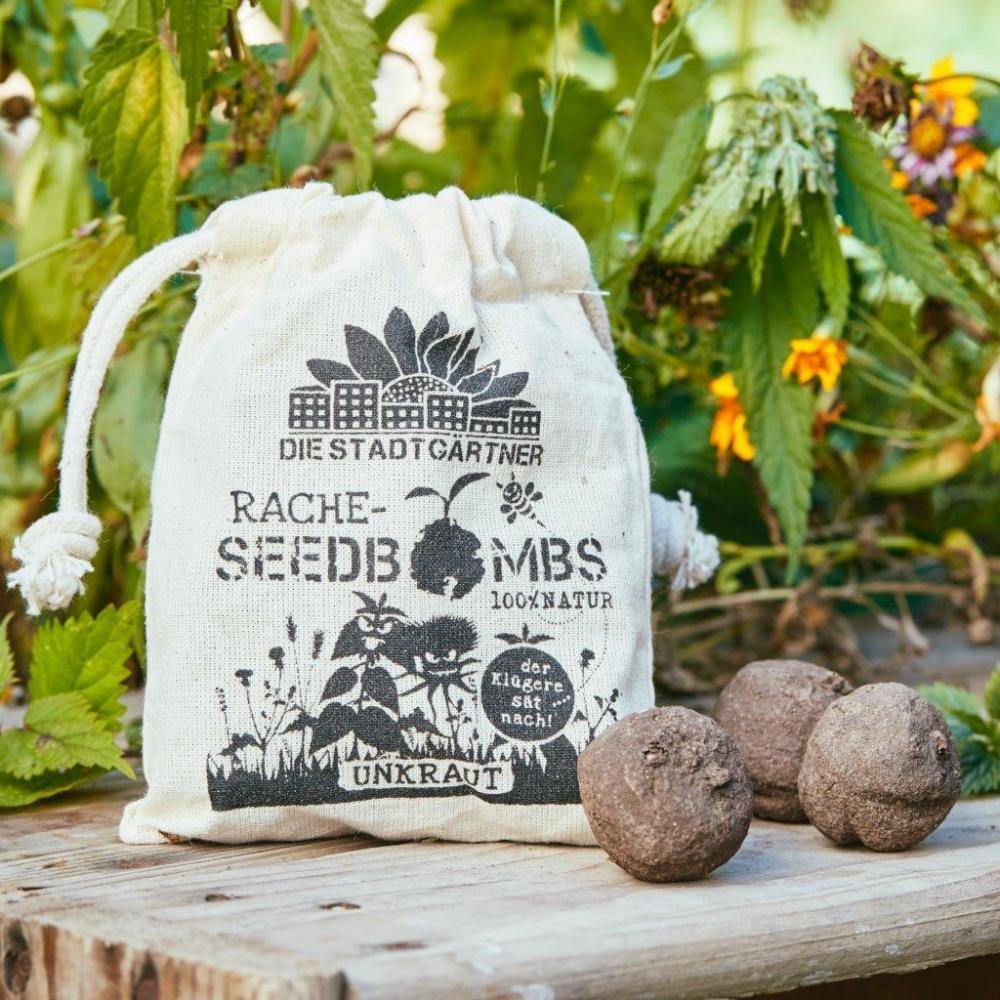
Seed bombs
Gardening comfortably from your deck chair? Greening up your dreary commute? Or giving an easy-care bouquet as a gift? No problem with our seed bombs! Simply toss them onto the desired area, wait, and enjoy the results.
Our handmade seed bombs from Germany are available in eight different varieties, ranging from wild flowers to delicious herbs and vegetables.
Packaged in a small jute bag (8 per bag) and about the size of a walnut, these seed bombs are also a great gift idea. They consist exclusively of local seeds, clay, and soil. Depending on the weather, the ideal time to throw them is between April and August. When kept in a dry and dark place, the seed bombs can be stored for up to two years without any issues.
How are the seed bombs produced?
Every single seed bomb is lovingly crafted by hand. We roll the majority of the seed bombs ourselves. Additionally, we receive support from the local Lebenshilfe and the Meppen correctional facility. The first step is always to carefully sift the soil to ensure the seed bombs remain free of small twigs or pebbles. Then, the soil is combined with clay powder, seeds, and water in a large mixer, which eventually produces a moist, sticky mass. We divide this into equal portions, which we then roll into roughly 2.5 cm balls—our seed bombs. Once dry, the seed bombs are rock-hard and ready for use for at least 2 years!
Seed bombs - What are they?
Seed bombs are small balls (or lumps) made of soil, clay, and seeds. Since the seeds are well-embedded in the rock-hard mix of soil and clay, they do not need to be planted. Instead, you can simply throw, roll, place, or catapult the entire seed ball to its destination. The next rain softens the ball and activates the seeds, which then begin to germinate.
There are varying opinions on how, when, and where the concept of seed balls was invented. Most people believe the idea originated with the ancient Egyptians, who used seed bombs to quickly cultivate the fertile farmland left behind by the annual flooding of the Nile. Later, the Japanese adopted the idea and used seed bombs dropped from airplanes to cultivate large fields while much of the (male) population was away during World War II.
Seed balls truly became well-known in the 1970s, when more and more people began throwing them to protest against urban concrete deserts, air pollution, and the development of urban green spaces. To this day, seed balls are used for exactly this purpose: to create colorful islands in dreary city centers, to beautify one's neighborhood, and to grow one's own food. Furthermore, seed bombs are also ideal for planting in balcony pots, making a quick change to a garden, or simply growing a few herbs in your kitchen.
Throw, wait... and still no joy!?
Seed bombs, seed balls, or growing projectiles. There are many names for these small balls of soil, clay, and seeds, but the principle always remains wonderfully simple. Just throw, wait, and enjoy the result every day. But what happens if, after your ambitious throw, the joyful result fails to appear?
We continue to produce our seed bombs by hand with love on our farm in Nordhorn. Jan, our #1 seed bomb roller, uses only the best ingredients for this: black potting soil, clay powder, and high-quality, local seeds from specialized dealers in Germany. From every batch of seed bombs, we take a few balls and hold a so-called "trial throw" to ensure that our cities really do become greener.
Despite our high quality standards, we remain to some extent at the mercy of nature. For this reason, we occasionally receive mail from dedicated urban gardeners out there who have thrown wild and waited patiently, but have yet to find a reason to rejoice. To make your chances of having colorful flower meadows and flourishing vegetable plants as lush as possible, we have compiled a checklist with the most important points for an optimal result:
- If you plan to transform your new building plot of thick clay lumps and gravel into a lush floral display, you won't be able to avoid hauling in some black potting soil, because the fine roots of the seedlings cannot gain a foothold on hard and dry ground.
- Even if it sounds almost too simple: the seed bombs are just thrown, placed, or rolled out. If you mean well and dig the balls into the ground, unfortunately, they won't grow. So, save yourself the tedious bending over!
- Our seed bombs need plenty of water! Especially at the beginning, it is important to water the brown balls generously so that they can soak up water thanks to the clay powder they contain. You can tell when you have watered enough if the seed bomb feels like modeling clay when pressed. Be sure to never let the seed bombs dry out completely!
- We are often asked if seed bombs also grow in the shade. The clear answer to this is: YES and NO! Our varieties Butterfly Meadow, Wild Meadow, Blooming Cornfield, Wildflowers, Daisies, and Bee Feast contain dozens of different species, some of which thrive in the sun while others feel comfortable in the shade. Depending on the location you choose, you will get a corresponding result. The Italian Garden, Wild Herbs, and Sunflower varieties are true sun-worshippers and are unsuitable for shady spots. Generally speaking: the more sun, the more lush the blossoms!
- The last point on the list is based on a true story. There was once the tricky case of a customer who did everything perfectly and yet couldn't enjoy colorful flowers. After much back-and-forth, we got to the bottom of the secret. The culprits in this case were cheeky birds that stole the seeds every time she had thrown the seed bombs. As I said: to some extent, we are simply at the mercy of nature!
Annual or perennial... that is the question!
For our seed bombs, we use seed mixtures that are mostly annual, although some also contain a portion of perennial varieties. What does that mean? With the annual seed mixtures, it means that you can admire the wildflower meadow in its full glory in the very first year after sowing, and you don't have to wait until next year or the year after.
Germination begins about 14 days after scattering. After a total of 6 to 8 weeks, your colorful wildflowers will be in full bloom, depending on the season and weather conditions. Shortly before the end of the flowering period, the wildflowers will re-seed themselves, so that with a bit of luck, you can look forward to the next generation the following year. The few perennial varieties require between one and two years to get started before they bloom. You can read which mixtures contain annual or perennial species under the respective seed bomb variety.
28 products