


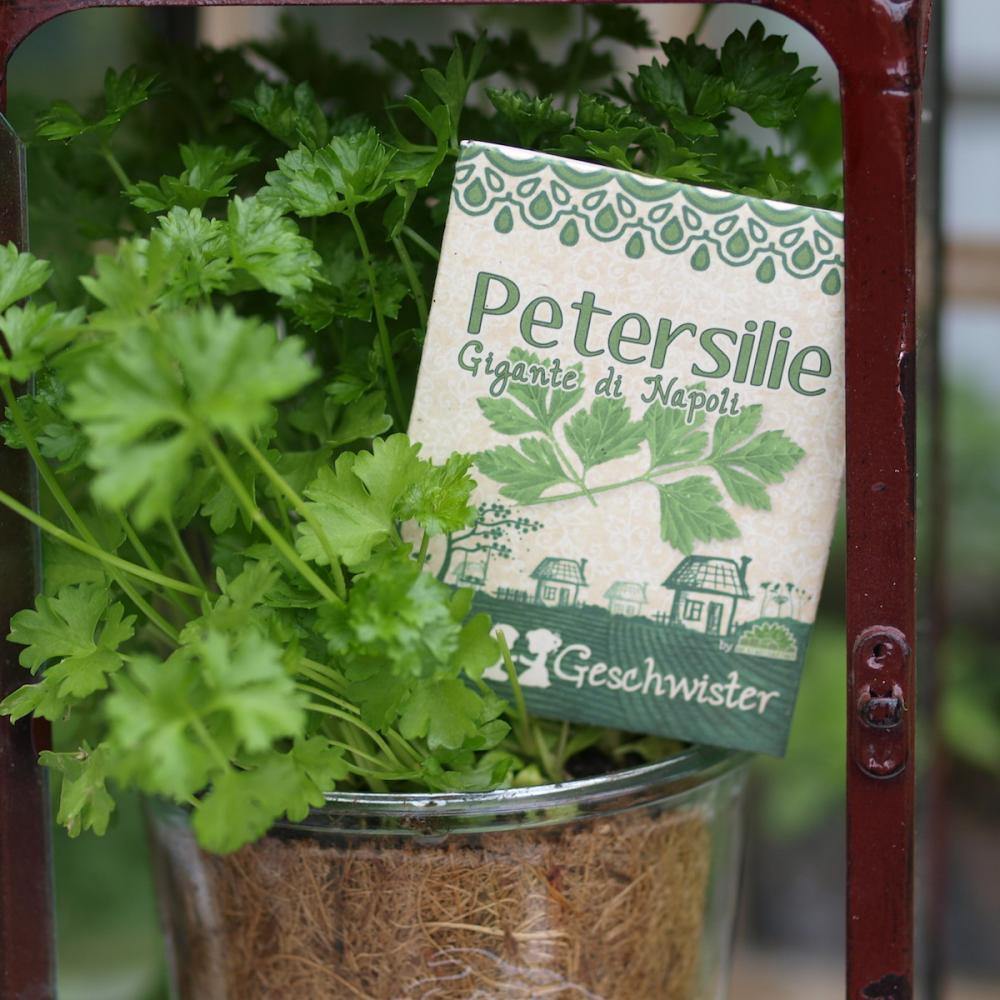

Properties
| Plant information | |
|---|---|
| year-round | |
| light feeder | |
| Petroselinum crispum | |
| 30-40 cm | |
| perennial | |
| Green | |
| Versatile culinary herb | |
Planting instructions on the envelope
Optimal conditions for perennial parsley are a bright location without constant, strong sunlight and nutrient-rich, well-drained garden soil that does not become waterlogged. The plant should be fertilized regularly to ensure it is sufficiently supplied with nutrients and that harvested leaves can quickly regrow. It reaches a height of up to 40 cm.

Detailed planting instructions: Parsley "Gigante di Napoli"
Fresh parsley—and this is more of an objective statement than a mere claim—is a real all-rounder in the kitchen. This spice from the Apiaceae family, which has curly or flat leaves depending on the variety, provides the right seasoning for every stew, soup, and potato dish. But the herb is also adept at refining other vegetable dishes, savory quark dishes, fresh salads, and quite a few sauces when it comes to serving up a meal, and it has been doing so for three millennia. It is not for nothing that it is a permanent component of soup greens. And not for nothing, but for very little money, you can grow parsley yourself in the garden, on the balcony, or in the kitchen. Between us: it's actually quite simple.
Delicious cultivated plant with many names
By the way, there are many names for the herb; it is also referred to as "Peterling," "Peterle," "Petergrün," "Peterli," or "Silk" in German-speaking regions for this tasty cultivated plant. It likely originated in Southeast Europe and Western Asia. Where it ends up is also clear: as a great herb for your dishes, but the gods have put a little hard work before that pleasure. Parsley (we'll stick with the most common term) does not reach harvest maturity all by itself.
Sowing plenty of seeds is the way to go
Whether indoors or outdoors, in a pot, tub, or bed, it is crucial that you always use plenty of parsley seeds when growing it. While the plant grows up to 30 centimeters tall and bears countless leaves, it takes quite a long time to do so. It is better to sow plenty, which increases the yield during harvest even when the parsley is still quite small. You should loosen the soil in which the slow-growing seedlings are sitting every now and then after sowing, perhaps with a rake.
And of course, nothing grows without water, including parsley. If the soil is kept consistently and evenly moist, it will actually thrive and not grow quite so slowly. But be careful not to overwater, as it is very sensitive to waterlogging and will practically die under your fingers. If you plant the herb in a bed, soil enriched with humus is recommended. If, on the other hand, you grow parsley in a pot or tub, it does not hurt to fertilize a little bit shortly after sowing.
Harvest and use
If things go well, you can harvest the first leaves after just two months. How you use the parsley is a matter of taste. The herb has its appeal not only when fresh, but also when dried. If you can harvest a large amount again in the autumn, it doesn't hurt to dry the leaves over the winter so that you always have a great basic spice on hand for soups and stews. And if you like, you can also brew a tea from the dried plants. It is said to promote digestion and act as a diuretic. Enjoy!
The seeds of this herb need neither a green thumb nor complicated tricks to flourish into tasty parsley. Even the location is quite forgiving. It is only important that you find a spot that is semi-shaded if possible. And one that features soil that contains nutrients. Whether that is in the garden, in a plant container on the balcony, or in a pot on the windowsill in the kitchen really doesn't matter. It is only important that you wait until there is no more frost if you plan to plant the parsley—as it is called in Bavaria and Austria—outdoors. Indoors, i.e., in the house, that is possible even earlier.